
Operational
Convert 20 kilobytes to bits - 20 kb to bit calculator
Advertisement
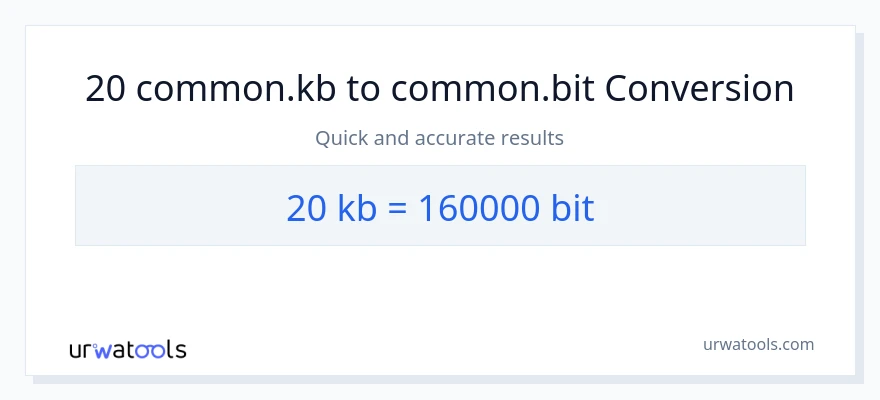
20 Kilobytes = 160,000 Bits
Twenty kilobytes are equal to approximately one hundred sixty thousand bits
Related searches for 20 Kilobytes to Bits
Users often phrase this conversion in slightly different ways. You might see searches like "20 kb in Bits," "convert 20 Kilobytes to Bits," or "how many Bits is 20 kb?" Regardless of the wording, the result remains the same: 20 Kilobytes equals 160,000 Bits.
Conversion Table: 20.1kb to 20.9kb
Conversion Table: 20.1kb to 20.9kb
Quick reference guide for kilobytes to bits conversions between 20.1 kb and 20.9 kb.
| Kilobytes (kb) | Bits (bit) | Bytes (byte) |
|---|---|---|
| 20.1 kb |
160,800 bit
|
20,100 byte
|
| 20.2 kb |
161,600 bit
|
20,200 byte
|
| 20.3 kb |
162,400 bit
|
20,300 byte
|
| 20.4 kb |
163,200 bit
|
20,400 byte
|
| 20.5 kb |
164,000 bit
|
20,500 byte
|
| 20.6 kb |
164,800 bit
|
20,600 byte
|
| 20.7 kb |
165,600 bit
|
20,700 byte
|
| 20.8 kb |
166,400 bit
|
20,800 byte
|
| 20.9 kb |
167,200 bit
|
20,900 byte
|

Common Kilobytes to Bits Amounts
Other Kilobytes Conversions
Frequently Asked Questions
-
20 common.kb is equal to common.bits 160000.
-
Use the appropriate conversion factor. For example, 20 common.kb equals common.bits 160000.
-
Yes. 20 common.kb equals common.bits 160000, which is more than one 160000.
-
Value in 160000 = value in common.kb × conversion factor. Example: 20 common.kb = common.bits 160000.
-
It helps to express measurements in the most convenient unit. For long distances, common.bits may be easier than common.kb.
-
There are common.bits 160000 in 20 common.kb.
-
Yes. Enter any value in common.kb to get the result in common.bits.
-
This conversion is common in science, engineering, and everyday life.
-
Cloud backups, video exports, and software updates list sizes in different units. Converting Kilobytes to Bits shows whether you have enough space or bandwidth.
-
IT teams compare file sizes, database growth, and streaming bitrates by moving between Kilobytes and Bits to match vendor requirements.
-
Multiply by 8,000 to convert Kilobytes into Bits. Use the same factor for estimating storage upgrades or compression savings.