
11 Best Proxies for Web Scraping Compared (2026)
Compare 11 web scraping proxies on measured success rates, IP quality, pricing and session control, plus a testing method to pick the right one.
 UrwaTools Editorial Updated
Contents
11 Best Proxies for Web Scraping Compared (2026)Finding the best proxy for web scraping is not as simple as picking the provider with the biggest IP pool or the lowest price.
The right choice depends on what you scrape, how often you scrape it, where the data is located, and how aggressively the target website protects its pages.
For a small public-data project, a low-cost datacenter proxy may be enough. A large e-commerce scraper may need residential IPs, precise geo-targeting, and session control. A team collecting data at scale may prefer a managed scraping API instead of operating the whole proxy stack itself.
This guide compares the major options, explains the proxy types, and shows how to choose the right setup for your workload.
Quick takeaway: there is no single best proxy for every scraping project. A practical shortlist includes Decodo for an all-round balance, Bright Data and Oxylabs for enterprise workloads, Webshare for budget-conscious users, IPRoyal for flexible residential access, and specialist scraping APIs such as Zyte or Crawlbase when you want less infrastructure to manage. Provider pricing changes frequently, so verify current rates before purchase.
How this comparison was built: no proxies were purchased and no requests were sent for this article. Performance figures come from independently published proxy market research whose data was collected in March and April 2026 across 13 providers and millions of connection requests. Pricing reflects standardised comparisons and vendor pages checked in mid-2026. Provider marketing claims are labelled as such.
Best Proxy Providers at a Glance
| Provider | Best for | Main proxy types | Pricing approach | Standout strength |
| Decodo | Most mid-sized scraping projects | Residential, datacenter, ISP, mobile | Per GB / per IP by product | Strong balance of coverage, targeting, tooling and price |
| Bright Data | Enterprise scraping | Residential, datacenter, ISP | Tiered plans and usage-based options | Large network and broad scraping platform |
| Oxylabs | Enterprise data collection | Residential, datacenter, ISP, mobile | Tiered bandwidth plans | Highest independently measured success rate |
| Webshare | Budget projects | Residential, datacenter, ISP | Low-cost self-service plans | Low entry price, strong datacenter performance |
| IPRoyal | Flexible residential purchasing | Residential, datacenter, ISP, mobile | Pay-as-you-go and subscriptions | Cleanest measured IP reputation |
| SOAX | Precise location targeting | Residential, mobile, datacenter | Usage-based | Fine-grained filtering, long session uptime |
| NetNut | Committed enterprise contracts | Residential, ISP, datacenter, mobile | Usage-based / custom | Very high datacenter throughput |
| Rayobyte | Flexible proxy mix, US volume | Datacenter, ISP, residential, mobile | Product-dependent, scaling PAYG | Broad product range at low volume rates |
| NodeMaven | Session-oriented scraping | Residential, ISP, mobile | Usage-based | IP quality filtering and long sticky sessions |
| Zyte | Managed scraping | Proxy / API stack | Per successful request | Moves proxy management into a wider workflow |
| Crawlbase | API-led scraping | Proxies and crawling API | Per successful request | Charges only for successful requests |
The table is a starting point, not a universal ranking.
Published rates differ sharply by tier. In standardised mid-2026 comparisons, Decodo listed residential from about $3.75/GB at 5 GB down to roughly $2.00/GB at 1 TB; Oxylabs from about $6.00/GB at 5 GB to $2.50/GB at 1 TB; Webshare from about $3.50/GB down to $1.50/GB; and Rayobyte from about $3.50/GB at entry to around $0.70/GB at 1 TB. Bright Data sits at the premium end, with pay-as-you-go residential list rates reported between roughly $5 and $8.40/GB depending on plan and active coupons, falling with commitment.
Two 2026 changes matter more than any single number. Several providers withdrew long-running 40–50% coupon codes, so effective residential rates rose for the first time in three years — one provider's rates roughly doubled. At the same time, some budget providers halved theirs. Always check the live pricing page.
What Makes a Proxy Good for Web Scraping?
A proxy is useful only when it solves the problem your scraper actually has.
Five things usually matter most.
- IP quality. A large IP pool is not automatically a good one. Shared or heavily abused addresses perform poorly. In 2026 reputation testing, the spread between providers was wide: the cleanest pool had roughly 17% of its global IPs flagged as proxies by third-party databases, while the worst was around 56%.
- Location. If a website changes results by country, city, state, ASN, or ZIP code, broad country targeting may not be enough. Verify that targeting actually works — in the same 2026 tests, one provider's "US" datacenter pool was only 71–76% genuinely US-located depending on the geolocation database used.
- Session control. Some jobs need a fresh IP on every request. Others need one IP to remain stable for a complete session.
- Reliability. A cheap proxy that fails half your requests can cost more than a premium proxy that consistently returns the data you need.
- Total cost. Compare the price of successful data collection, not just the advertised cost per GB.
That last point is easy to miss, and the next section shows exactly how much it matters.
The Number That Decides Everything
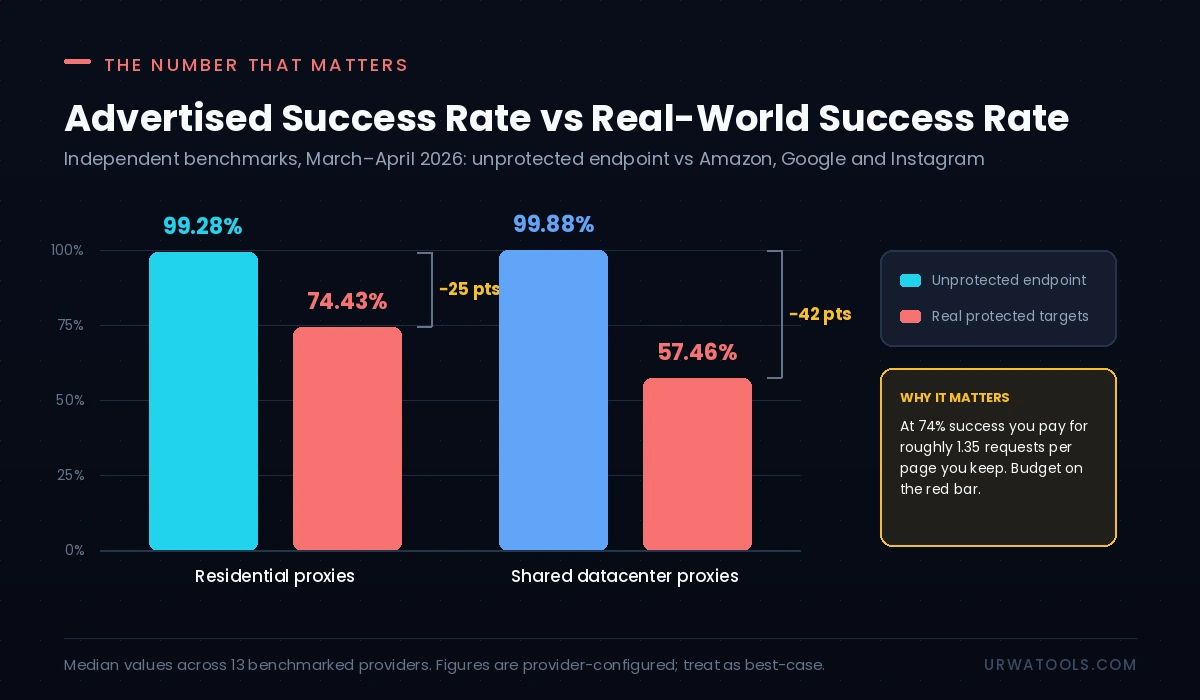
Almost every proxy provider advertises a success rate above 99%. Those numbers are usually real. They are also close to useless for predicting how your scraper will perform.
Independent 2026 benchmarking measured two different things across 13 providers.
Against a plain endpoint that blocks nobody — pure infrastructure reliability — residential networks posted a median success rate of 99.28%, with the best at 99.93%.
Against real protected targets such as Amazon, Google and Instagram, the same networks posted a median success rate of 74.43%. The best performer reached 81.23%.
Shared datacenter proxies showed a wider split: roughly 99.88% infrastructure success against a 57.46% median on real targets.
Two practical consequences follow.
The gap between targets is larger than the gap between providers. Across those benchmarks, the difference between the best and worst provider on real targets averaged only about ten percentage points. Switching vendors to fix a hard target usually disappoints; changing proxy type, request pattern or approach usually works.
A 74% success rate means you pay for roughly 1.35 requests for every page you keep. That is the number your budget should be built on, and almost nobody builds it that way.
Translating provider claims
| What they advertise | What it actually tells you |
| "175M+ IPs" | Addresses available over time. In a 3.6M-request test over three weeks, the largest network returned about 3.24M unique IPs. Above roughly 30–40 million, pool size stops predicting performance. |
| "99.9% success rate" | Infrastructure uptime against an easy endpoint. Not your success rate. |
| "Sub-second response time" | Usually measured near their gateway. If their gateway is in Virginia and you are in Karachi, your latency is a different number. |
| "195+ countries" | Countries where at least one IP exists. Ask instead how many IPs exist in the city or ASN you need. |
| "Ethically sourced" | An unaudited claim unless backed by a named certification or a published sourcing method. |
How We Compare Proxy Services
A useful proxy comparison should go beyond marketing claims. The main criteria are below.
- Success rate. How often does the proxy return a usable response from your target? A fast connection has little value when most requests fail.
- Response time. Latency affects both scraping speed and infrastructure cost. Benchmarked global medians for residential proxies in 2026 ran around 0.93 seconds, with the fastest at 0.41 and the slowest near 1.9 — roughly a fourfold spread.
- P95 latency. More useful than the median. A network with a 0.6s median and a 12s P95 will stall your concurrency pool.
- IP reputation. Residential IPs resemble ordinary consumer traffic more closely than most datacenter ranges. This does not make residential proxies automatically better for every website.
- Geographic accuracy. A provider may advertise a country while offering less precise control over the exact area you need.
- Rotation control. You may need a new IP for each request, a new IP after a defined period, a persistent session, or a custom session identifier.
- Concurrency. If your scraper sends many requests simultaneously, the provider must support the workload without becoming the bottleneck.
- Gateway location. Providers with a single US gateway post noticeably worse latency everywhere else. If you operate from South Asia, check for an Asian point of presence.
- Support and integration. Documentation, authentication options, dashboards, APIs and support matter more as the project grow
Best Proxy Providers for Web Scraping Compared
Each profile below separates what was independently measured from what the vendor claims. Pros and cons are weighted for scraping specifically — a feature that matters for account management may be irrelevant here.
1. Decodo — Strong All-Round Choice
Decodo, known as Smartproxy until April 2025, is one of the most balanced choices for general web scraping.
Its residential offering advertises 115M+ IPs across 195+ locations, with HTTP(S) and SOCKS5 support, continent/country/state/city/ZIP and ASN targeting, rotating and sticky sessions, and unlimited concurrent sessions.
Why it stands out. In 2026 independent benchmarks Decodo placed second on residential infrastructure success rate at 99.92%, recorded the fastest global residential response time at 0.53 seconds, and returned the most unique US IPs of any provider tested. It performed strongly on real targets while pricing near the market median.
It is a strong fit for e-commerce scraping, SERP collection, market research, price monitoring, geo-targeted data and general crawling. Its portfolio also includes datacenter, ISP, mobile and scraping-focused tools.
Pros
-
Second-highest measured residential success rate in 2026 (99.92% global)
-
Fastest global residential response time recorded (0.53s), and fastest mobile response on real targets
-
Returned the most unique US IPs of any provider benchmarked
-
All four proxy types plus scraping APIs on one account
-
Deepest targeting set available: continent, country, state, city, ZIP and ASN
-
Retained both subscription and pay-as-you-go while rivals removed PAYG
-
SOCKS5h with UDP and QUIC support; sub-users and IP whitelisting included
-
Three-day trial plus a 14-day refund window
Cons
-
Strong everywhere, best-in-class almost nowhere except speed — no single differentiator
-
Rates rose roughly 22–33% year over year as long-running discounts were withdrawn
-
The headline per-GB rate only applies at higher volume tiers
-
Auto-rotates after 60 seconds of inactivity by default, which silently breaks slow multi-step workflows
-
Gateway locations limited to Germany, Canada and Singapore
Best for: the best evidence-to-price ratio in the category — freelancers, agencies, developers and mid-sized scraping teams.
Main limitation: it has no single standout differentiator. The lowest advertised rate depends on volume, so a small project should compare the effective cost rather than assume the headline rate applies.
2. Bright Data — Best for Enterprise Scale
Bright Data is built for organizations that need a broad proxy ecosystem rather than a basic proxy endpoint.
It advertises a residential network in the hundreds of millions of IPs across 195 countries, plus products that go well beyond raw proxies: Web Unlocker, Scraping Browser, SERP API and pre-built datasets. It holds the most complete compliance certification set in the category.
Why it stands out. Breadth. A larger organization may need multiple proxy types, detailed geo-targeting, large concurrency, browser automation, data collection APIs and centralized control in one contract.
Important context: Bright Data did not participate in the 2026 independent benchmarks, so its performance claims are provider-reported rather than independently measured. It discontinued its mobile proxy product in April 2026, and full residential access requires a compliance review — personal and hobby projects are not supported.
Pros
-
Largest publicly disclosed residential network in the market
-
Widest product suite: Web Unlocker, Scraping Browser, SERP API and ready-made datasets
-
Most complete compliance posture of any provider — GDPR, CCPA, ISO 27001 and SOC 2
-
Meaningful legal track record, having prevailed in Meta v. Bright Data
-
City, ZIP, ASN and carrier-level targeting granularity
-
Steep volume discounts once you commit, with rates falling substantially from list
-
The most defensible choice for regulated-industry procurement
Cons
-
Absent from the 2026 independent benchmarks — every performance figure is provider-reported
-
Discontinued mobile proxies entirely in April 2026
-
Premium pay-as-you-go list pricing, reported in the $5–$8.40/GB range depending on plan and coupon
-
Compliance review, and possibly a video call, required before full residential access
-
Hobby and personal projects are explicitly unsupported
-
Calendar-month commitments that do not roll over; unused traffic is lost
-
"Unlimited" ISP and datacenter tiers carry per-IP fair-use allowances that trigger overage
-
Billing is genuinely complex — coupons, first-deposit matches and proration are easy to misread
Best for: enterprise teams and procurement processes that require documented compliance.
Main limitation: premium pricing and onboarding friction. Cost and configuration complexity should be considered together.
3. Oxylabs — Best for Large-Scale Data Collection
Oxylabs sits at the premium end of the market and earned it in testing.
It topped the 2026 residential infrastructure benchmarks at 99.93% global success, advertises the largest pool in that report at 175 million IPs, and returned the most unique IPs of any network tested. Residential pricing ran from about $6/GB at 5 GB down to $2.50/GB at 1 TB, with sticky sessions, flexible rotation, and HTTP(S) and SOCKS5 support.
Why it stands out. Measured performance plus a full product line including scraping APIs and a browser.
Pros
-
Highest measured residential success rate in the 2026 field (99.93% global, 99.96% in Australia)
-
Returned the most unique IPs of any network tested — roughly 3.24M across 3.6M requests
-
Largest advertised pool in the report at 175 million residential IPs
-
Second-fastest global response time (0.60s) with tight latency distribution
-
Full product line: residential, datacenter, ISP, mobile, scraping APIs and a browser
-
Added 18+ datacenter countries in a single year
-
ISO 27001 and GDPR certified with enterprise support and dedicated account management
-
Sub-users, IP whitelisting, SOCKS5h and QUIC support
Cons
-
Removed self-service pay-as-you-go in 2026, raising the entry point sharply to around $30
-
Premium pricing — roughly $6/GB at 5 GB, well above the market median
-
Small datacenter pool (~40,000 IPs) concentrated in only about 89 /24 subnets, so range blocks remove many addresses at once
-
ASN targeting available but not enabled by default
-
Difficult to justify for any scraper below roughly 100 GB per month
-
Gateways limited to Germany, Canada and Singapore
Best for: large companies and serious production workloads.
Main limitation: the pricing is difficult to justify for a small scraper. Oxylabs removed self-service pay-as-you-go in 2026, raising the entry point substantially. Its datacenter pool is also small and concentrated in relatively few subnets, so it needs careful use to avoid range blocks.
4. Webshare — Best Budget-Friendly Option
Webshare is attractive when price and self-service access are the priorities. It has been owned by Oxylabs since 2022.
It halved its rates in the year to March 2026, with standardised residential pricing from about $3.50/GB at 5 GB down to roughly $1.50/GB at 1 TB, plus a free tier.
Why it stands out. Its shared datacenter proxies posted the best real-target success rate of any datacenter product tested in 2026 at 79.84% — better than most residential networks, at a fraction of the price — with well-balanced subnet diversity.
Pros
-
Best datacenter real-target success rate measured in 2026 (79.84%), beating most residential networks
-
Halved its rates year over year — among the cheapest credible options at every tier
-
Genuine free tier for testing before spending anything
-
Well-balanced datacenter subnet spread (~389 /24 subnets), reducing range-block exposure
-
Widest gateway distribution of the group: Europe, both US coasts, Australia and Japan
-
Strong self-service platform with sub-users and IP whitelisting
-
Residential pool grew 167% year over year to 80M advertised IPs
Cons
-
No ASN targeting; location filtering limited to country and city
-
Fewer advanced features than mid-market rivals
-
Residential success rate mid-field (99.28%) and down 0.30 points year over year
-
Owned by Oxylabs, so it is not a genuinely independent second source if you are diversifying vendors
-
Charges upsells for extra threads and network priority
-
Only a two-day refund window, and no true trial on paid residential
Best for: first purchases, development, testing, and any target that tolerates datacenter traffic.
Main limitation: fewer targeting options and no ASN filtering. The cheapest option is not automatically right for difficult targets.
5. IPRoyal — Best for Flexible Residential Purchasing
IPRoyal suits projects that do not want a large monthly commitment, offering both subscription and pay-as-you-go residential access.
Why it stands out. It had the cleanest IP pool of any provider in the 2026 reputation checks by a clear margin, both globally and in the US — a notable turnaround from previous years.
Pros
-
Cleanest measured IP pool in the 2026 field by a wide margin — roughly 16.7% of global IPs flagged as proxies, against 56% for the worst performer
-
Lowest average risk score in both the global and US pools
-
Pay-as-you-go retained, with a proper subscription model newly added
-
Expanded ISP coverage past 30 countries with city and state targeting
-
Domain whitelist and blacklist controls, plus the option to exclude ISP proxies and IP ranges
-
New continent-level and coordinate-based targeting
-
Runs its own sourcing app rather than relying purely on upstream resale
Cons
-
Infrastructure success rate regressed sharply to 96.11%, down about 3.5 points year over year, after clearing 99% the previous year
-
Prices roughly doubled when the long-running 50% coupon was withdrawn — now among the least competitive per GB
-
Mid-field response times (1.24s global) with noticeably less stability than the leaders
-
Its unfiltered global pool was only 86.77% genuinely residential, far below its country-filtered pools
-
The 2026 report flagged around 900,000 US IPs tied to unusual Comcast ASN activity — worth asking the vendor about directly
-
ASN targeting available but not by default
-
Trials are company-only, so individuals cannot test before paying
Best for: one-time data projects, prototypes, smaller scrapers and irregular workloads where IP reputation matters.
Main limitation: two things to verify. Its infrastructure success rate regressed to 96.11%, down about 3.5 points year over year, and its prices roughly doubled when a long-running 50% discount was withdrawn. Response times were mid-field. Check current pricing carefully.
6. SOAX — Strong Choice for Detailed Targeting
SOAX is especially interesting when your scraper needs flexible location and filtering controls. It advertises around 155M residential IPs across 195+ countries with state, city, ASN, ISP and ZIP-level targeting.
Why it stands out. It led the 2026 field on measured session persistence — its residential IPs stayed online longest — and posted the best US infrastructure success rate at 99.92%.
Pros
-
Longest measured session persistence of any residential network tested — the key spec for multi-step work
-
Best US infrastructure success rate in the field (99.92%)
-
Second-largest advertised residential pool (155M) and the largest mobile pool (33M)
-
Granular targeting including ASN and ISP selection
-
Smart rotation that can hop between carrier and Wi-Fi networks with similar parameters
-
Configurable inactivity threshold and strict-session support
-
Unified platform spanning proxies, scraping APIs and datasets
-
Cheap paid trial at under $2 for 400 MB
Cons
-
Discontinued its ISP proxy product entirely
-
Removed pay-as-you-go, raising the entry point substantially
-
Its unfiltered pool returns IPs near the requester's own location unless an undocumented parameter is used — a genuine trap for global scraping
-
Datacenter product downscaled to US-only, having removed six countries
-
No sub-user support
-
Only 94.12% of its India pool was genuinely residential, well below its other regions
Best for: projects where geography and long sessions matter as much as proxy volume.
Main limitation: it discontinued its ISP product and removed pay-as-you-go, raising the entry point. One quirk: without an undocumented parameter, its unfiltered pool returns IPs near the requester's own location.
7. NetNut — Worth Considering for Stable Connections
NetNut is enterprise-focused and publicly traded, commonly positioned around ISP and residential connectivity.
Why it stands out. It posted the fastest datacenter throughput in the 2026 benchmarks by a wide margin — a genuine advantage for bandwidth-heavy work.
Pros
-
Fastest datacenter throughput measured by a wide margin (~112.5 MB/s against a 10.25 MB/s median)
-
Perfect US geo-accuracy on its datacenter pool in both geolocation databases tested
-
Added 21 datacenter countries in a single year
-
Publicly traded, so financials and customer concentration are disclosed rather than guessed at
-
Enterprise account management with annual contract options
-
Wide gateway spread across France, Germany, Finland, Canada and Singapore
-
Scrapers and datasets business grew from nothing to roughly $10M in 2025
Cons
-
Weakest residential success rate in the 2026 field (95.28% global), down about 3 points year over year
-
Highest share of IPs flagged as proxies (56.09% globally) and the highest average risk score
-
Only about 75% of its "mobile" IPs were actually on mobile networks; in Brazil closer to a quarter
-
Removed ASN targeting altogether
-
Slow residential response times (1.66s global)
-
No pay-as-you-go, with a $99 entry point and company-only trials
-
Heavy revenue concentration — six customers reportedly generated half of 2025 revenue, which is a supplier-stability consideration
Best for: large committed contracts with direct account management.
Main limitation: its residential network underperformed in the same tests, with a 95.28% global success rate and the highest share of IPs flagged by third-party reputation databases. It also removed ASN targeting. Choose it because its specific characteristics match your workload, not because of ranking position.
8. Rayobyte — Broad Product Mix
Rayobyte offers a wide range: static and rotating datacenter, ISP, residential, mobile and scraping products. Rotating datacenter traffic starts around $0.30/GB and residential from about $3.50/GB at entry, dropping to roughly $0.70/GB at 1 TB. It also cut mobile proxy rates by up to 98% in 2026.
Pros
-
Among the most aggressive volume pricing in the market — roughly $0.70/GB residential at 1 TB
-
Cut mobile proxy rates by up to 98%, making mobile cheaper than most residential options
-
Full product range across all four proxy types plus a scraping API and unblocking browser
-
Pay-as-you-go with scaling discounts and no subscription lock on most products
-
Second-best datacenter real-target success rate in the 2026 benchmarks
-
Well-balanced datacenter subnet diversity (~510 /24 subnets)
-
US-based with responsive US-centric support; strongest revenue growth in company history
Cons
-
HTTP only on residential — no SOCKS5, which rules out some tooling
-
A single East Coast US gateway, so latency degrades badly outside North America
-
No ASN targeting and no sub-user support
-
Its "US" datacenter pool was only 71–76% actually US-located depending on the database used — the worst geo-accuracy in the field
-
Residential success rate fell 1.45 points year over year to 98.02%, with slow response times (1.86s global)
-
Mobile coverage highly imbalanced by country, with minimal presence in the UK and India
-
Subscription pricing is enterprise-only
Best for: high-volume, US-centric work where price dominates.
Main limitation: real trade-offs. It supports HTTP only, runs a single East Coast US gateway that hurts latency elsewhere, offers no ASN targeting, and its "US" datacenter pool was only 71–76% actually US-located in testing.
9. NodeMaven — Strong Focus on Sessions and Scraping
NodeMaven positions on IP quality rather than pool size, advertising 30M+ filtered residential IPs, screening addresses against reputation databases before assignment, and sticky sessions lasting up to seven days.
Pros
-
Screens IPs against reputation databases before assignment rather than after failure
-
Sticky sessions lasting up to seven days — among the longest available anywhere
-
Residential and mobile access included in a single plan, avoiding two subscriptions
-
Unused traffic rolls over between billing cycles
-
City, ZIP and ISP-level targeting across 150+ countries
-
UDP support on ISP proxies, which prevents breakage on QUIC/HTTP3 targets
-
Formal proxy quality guarantee with bonus traffic for confirmed blacklisted IPs
-
Built by the team behind a widely used antidetect browser, so session handling is a core competence
Cons
-
Absent from the 2026 independent benchmarks — every performance and clean-IP claim is provider-reported
-
Most available review coverage is affiliate-driven, which inflates apparent consensus
-
Smaller advertised pool (30M+) than mid-market rivals
-
Higher entry pricing with limited flexibility for small or one-off projects
-
An earlier independent report found that quality filters of this type did not always improve measured fraud scores — verify the effect on your own targets before paying a premium for it
Best for: scrapers whose specific failure mode is flagged or low-reputation IPs.
Main limitation: NodeMaven did not participate in the 2026 independent benchmarks, and much available review coverage is affiliate-driven, so the clean-IP claims are provider-reported. Trial it against your own targets before committing.
10. Zyte — Best When You Want Less Proxy Management
Zyte, built by the team behind the Scrapy framework, belongs in a different category from raw proxy vendors. It prices per successful response using a difficulty-tiered model that starts very low for simple HTTP requests and rises sharply for browser rendering, with deep volume discounts.
Pros
-
Bills per successful response, so failed and blocked requests are not charged
-
Among the lowest entry costs in the category for simple HTTP requests — reported from around $0.13 per 1,000 on pay-as-you-go
-
Deep volume discounts, reported in the 25–52% range
-
Built by the Scrapy team, so it is a native fit for existing Scrapy codebases
-
AI-powered extraction returns structured data without manual selector maintenance
-
Scrapy Cloud provides hosted spider deployment alongside the API
-
Handles rotation, retries, rendering and unblocking, removing a whole maintenance surface
Cons
-
Browser-rendered requests cost dramatically more than simple ones, making budgets hard to forecast from a headline rate
-
Monthly commitment required above roughly $100 of spend
-
Reported response times slower than several competing APIs
-
Support responsiveness has drawn repeated criticism
-
Ties part of your stack to one framework's ecosystem
-
Per-request pricing becomes expensive at high volume compared with raw proxy bandwidth
Best for: teams that care more about obtaining reliable web data than operating proxy infrastructure, particularly existing Scrapy users.
Main limitation: a managed API can cost more than raw proxy traffic when the workload is simple, and usage-based pricing is harder to forecast than a flat plan.
11. Crawlbase — A Managed-Crawling Alternative
Crawlbase charges only for successful requests, which moves retry risk from your budget to the vendor — a meaningful advantage on hard targets. It covers datacenter, residential, ISP, mobile, rotating gateways and a crawling API, and is well regarded for high-volume e-commerce.
Pros
-
Charges only for successful requests, transferring retry risk to the vendor entirely
-
Free tier of up to 20,000 requests with no card required
-
Infrastructure proven at high volume, particularly on e-commerce targets
-
Pre-built extractors for common targets alongside raw HTML delivery
-
Commitment-free subscriptions, billed monthly or yearly at a discount
-
Straightforward documentation aimed at developers who prefer to parse HTML themselves
-
Pricing economics reportedly improve meaningfully as volume rises
Cons
-
No transparent public rate card above entry tiers — you must contact sales, which adds friction
-
JavaScript-rendered requests consume more credits than plain ones
-
Smaller proxy network than the major infrastructure providers
-
Less feature depth than full platforms like Bright Data or Zyte
-
Redundant if you already run a stable scraper and only need raw IP access
Best for: developers who want a crawling-focused service rather than a raw proxy pool.
Main limitation: pricing above entry tiers requires contacting sales, and a managed service may be unnecessary if you already have a stable scraper.
Which Proxy Type Is Best for Web Scraping?
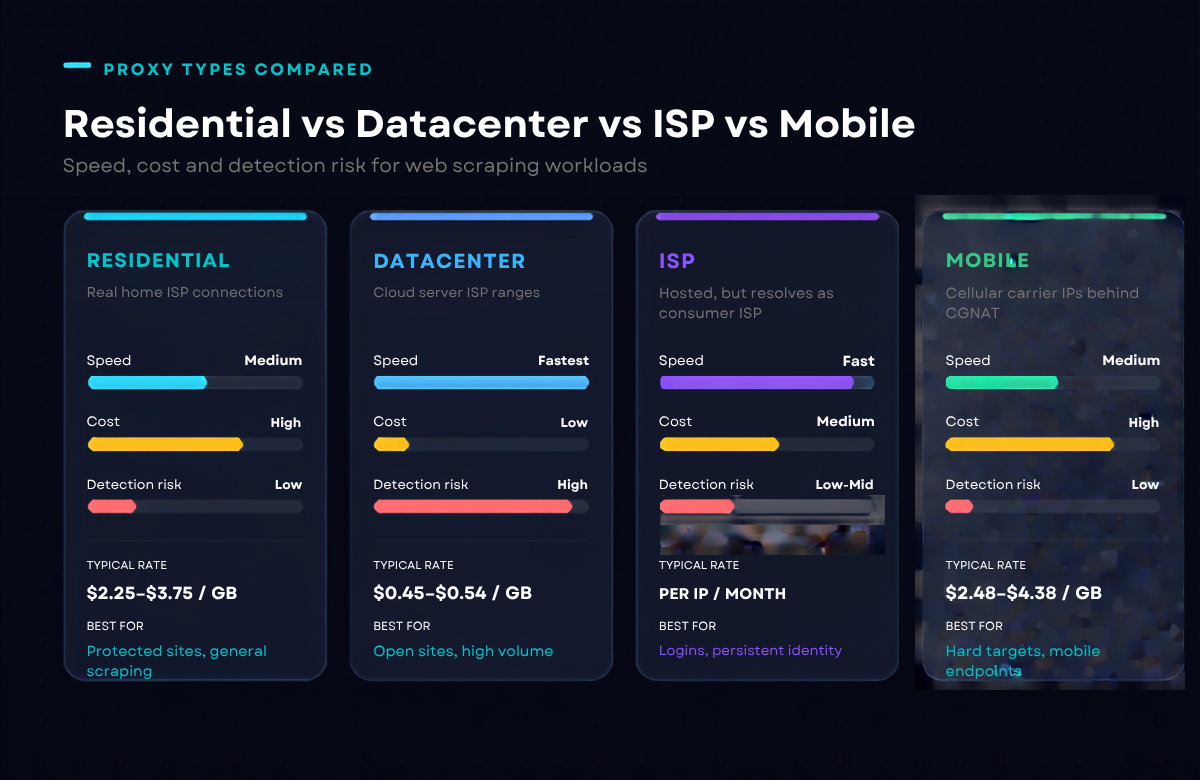
There is no universal winner. The best type depends on the target and the task.
Residential Proxies
Residential proxies route traffic through IP addresses assigned by consumer internet providers to real household connections.
Security research published after observing roughly four billion sessions concluded that residential proxies cannot be reliably identified through IP-level signals and static blocklists alone. That is the entire value proposition, stated by a party with no interest in selling proxies.
Good fit for: e-commerce, search engines, price monitoring, location-specific results, harder-to-access public pages.
Advantages: broad residential IP diversity, strong location options, useful where datacenter ranges perform poorly.
Limitations: more expensive, and bandwidth-based billing becomes costly at scale. Speed depends on a stranger's home connection.
Typical rate: median $3.75/GB at 5 GB, $3.00/GB at 50 GB, $2.25/GB at 500 GB in 2026 standardised comparisons.
Residential does not mean undetectable. Every target behaves differently.
Datacenter Proxies
Datacenter proxies are server IPs from cloud hosts — faster and cheaper, but their address ranges are published and easy to block wholesale.
The thing most guides miss: subnet spread matters more than IP count. In 2026 testing, one provider's US pool spanned just 89 distinct /24 subnets at roughly 244 IPs each, while another spanned 9,554 subnets at 1.22 each. A 60,000-IP pool concentrated in a few hundred subnets behaves like a few hundred IPs once a target starts range-banning, because one block removes hundreds of your addresses at once.
Good fit for: simple websites, high-volume low-friction crawling, development, speed-sensitive workloads.
Advantages: low cost, high speed, easy scaling.
Limitations: easier for anti-bot systems to classify; unsuitable for some protected targets.
Typical rate: roughly $0.45–$0.54/GB — five to six times cheaper than residential.
ISP Proxies
ISP proxies are datacenter-hosted servers using address space that resolves as consumer ISP space. They combine datacenter speed with a residential-looking origin, and are sold per IP per month rather than per gigabyte — which makes bandwidth effectively free and IP count the constraint.
Good fit for: long sessions, account-based workflows, persistent connections.
Advantages: session consistency and predictable connections. They are steadily replacing datacenter proxies as the default fast-and-stable option.
Limitations: sourcing is genuinely hard. They are often geo-located virtually rather than physically, so a "London" IP may sit in a Frankfurt rack. Major carriers have stopped leasing address space, tightening supply. One major provider discontinued its ISP product entirely in 2026.
Watch for: ISP proxies sold as traffic-metered rotating pools. That packaging discards the persistent identity that makes them worth buying.
Mobile Proxies
Mobile proxies use IPs from cellular carriers. Because carriers place thousands of subscribers behind a single address via carrier-grade NAT, blocking a mobile IP means blocking many real customers — which makes sites reluctant to do it.
The 2026 inversion: mobile used to cost two to three times residential and was reserved for last resorts. Rates have collapsed — one provider cut them by up to 98% — and at several volume tiers mobile now costs less than residential. Benchmarked medians ran $4.38/GB at 5 GB down to $2.48/GB at 500 GB. On real protected targets, mobile performed up to five points better than residential at its best.
Good fit for: mobile-centric platforms, app endpoints, and hard targets where residential is failing.
Limitations: higher entry points, median around $30. "Mobile" is also defined loosely by some vendors — one benchmark found a provider's Brazilian pool was only about a quarter genuinely mobile-network IPs.
Rotating Proxies vs Sticky Sessions
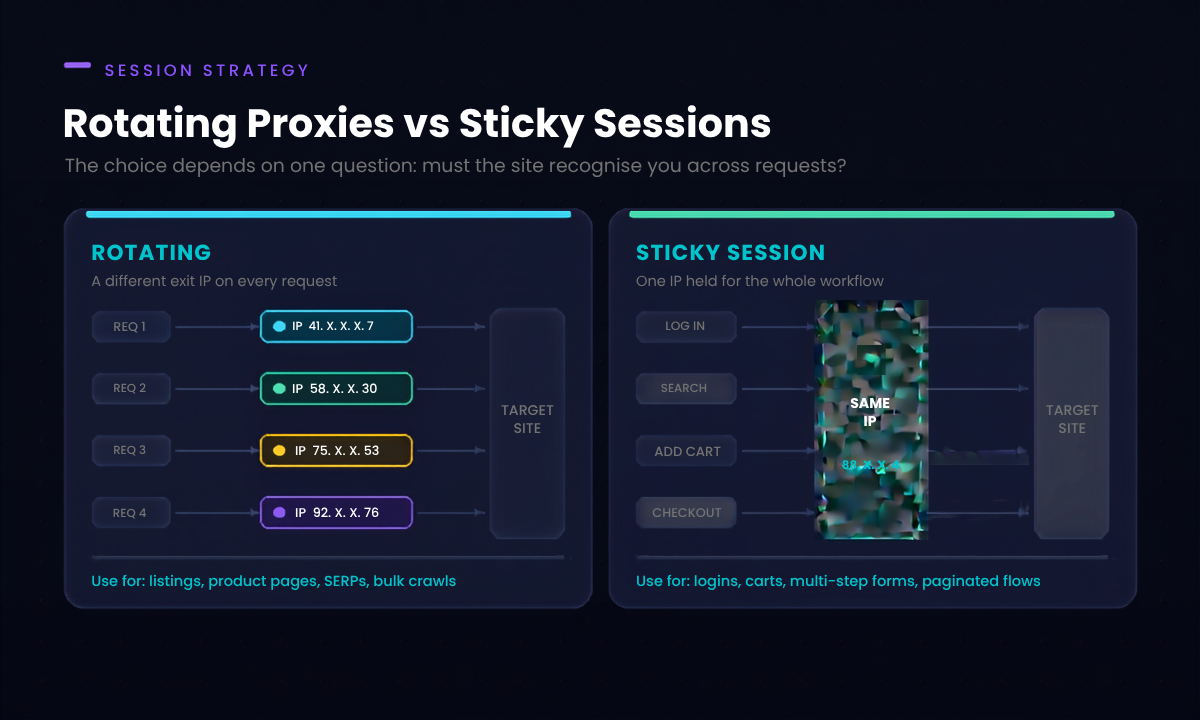
This choice is often more important than the provider name. Rotating and sticky are not quality tiers — they are two answers to one question: must the site recognise you across requests?
A rotating proxy changes the exit IP between requests or on a defined interval, distributing traffic across a larger pool.
A sticky session keeps the same IP for a period, so several requests belong to one consistent identity.
Use rotating proxies when: requests are independent, you want broad IP distribution, you collect many unrelated pages, or the target does not require a persistent identity.
Use sticky sessions when: login state matters, a shopping session spans several requests, the target expects a consistent IP, or a workflow contains multiple sequential pages.
Getting this wrong fails in both directions. Rotating mid-checkout drops the session and burns the work. Holding one IP through 50,000 requests concentrates your entire footprint on a single address until it is blocked.
What providers actually offer. Rotation on every request is universal. Sticky ranges vary from 10 seconds to 24 hours at most providers, and up to seven days at one. Defaults differ too — 6 minutes at one provider, 10 minutes at two of the largest, 30 to 40 minutes elsewhere. Several auto-rotate after 60 seconds of inactivity, which silently breaks slow multi-step workflows. Check that default before building around it.
The spec that is not on the pricing page: a maximum session duration is a ceiling, not a promise. Residential sessions end when the peer's device goes offline, whatever the documentation says. Measured uptime varied substantially in 2026 testing, with one provider leading the field and another consistently terminating around ten minutes. If persistent identity is critical, buy ISP proxies instead.
Match the Proxy to the Scraping Job
Choosing by use case is usually better than choosing by a generic "best provider" badge.
Search engine results. Use residential or mobile, rotating, geo-matched to the locale you are measuring — the IP is part of the data, since results are personalised by location. Search is among the hardest common targets, and in 2026 testing only a few networks opened it at a decent rate. For most teams a dedicated SERP API is the better purchase, because it removes both the proxy problem and the ongoing cost of maintaining parsers.
E-commerce data. Rotating residential is the safer starting point on protected product pages, but test datacenter first — retail sites vary enormously. Watch bandwidth: product pages are heavy, so request the HTML endpoint rather than rendering the full page, and skip image assets.
Price monitoring. Frequency, not volume, is the challenge — the same small set of URLs hit repeatedly is a recognisable pattern. Use conditional requests and change detection. Cloudflare has reported that more than half of AI crawler traffic re-fetches unchanged pages; fetching only what moved cuts a monitoring bill more than switching providers ever will.
SEO data collection. Rank tracking is location-sensitive by definition, so geo-accuracy matters more than raw speed. Verify that city targeting actually returns IPs in that city before committing.
Market research. Mixed: residential for protected sources, datacenter for open data, ISP for consistency. A provider with all four types on one account is worth more than a marginally better single-type network. Check whether an official API or open dataset already exists.
Large-scale crawling. Send everything through datacenter first at roughly a fifth the price, then retry only the failures through residential. On tolerant targets this tiered approach cuts spend more than any vendor switch. Watch subnet concentration and gateway location — at crawl scale, a pool spread across few /24 ranges collapses quickly.
Geo-specific data. Ask for IP counts in your specific target cities, not the country. Note that ASN targeting became less available in 2026, with several providers restricting or removing it following botnet-related security problems.
Login-based sessions. ISP proxies, one identity per account, held for the session's full life. Changing IPs too often creates unnecessary instability. Be aware that logging in changes your legal position — see the legal section below.
How to Measure Proxy Performance
Do not judge a proxy only by speed.
| Metric | What it tells you |
| Success rate | How often requests return usable results from your targets |
| Response time | How quickly responses arrive |
| P95 latency | Whether slow outliers will stall your concurrency pool |
| Connection time | How quickly a connection is established |
| Error rate | How frequently requests fail |
| Block rate | How often requests are rejected |
| Geographic accuracy | Whether the IP really appears from the intended location |
| Session stability | Whether sessions remain consistent in practice |
| Subnet diversity | For datacenter and ISP: how many /24 ranges the pool spans |
| Concurrency | How much parallel traffic the service handles |
| Cost per successful page | What successful collection really costs |
The last metric is the important one. A provider charging $2/GB can be more expensive in practice than one charging $3/GB if the cheaper traffic produces substantially more failures and retries.
The Real Cost Math
Here is the calculation that should drive your purchase.
Cost per successful page = (price per GB × page weight in GB) ÷ success rate
Using a median inner page weight of roughly 2 MB (per HTTP Archive's 2025 data) and the 2026 benchmark success-rate range, a job of 100,000 product pages works out approximately as follows. These are calculated illustrations, not measurements:
| Approach | Rate | Assumed success | Traffic incl. retries | Calculated cost |
| Datacenter, target tolerates it | $0.50/GB | 80% | 250 GB | ~$125 |
| Datacenter, protected target | $0.50/GB | 57% | 351 GB | ~$176 |
| Residential, mid-market | $2.50/GB | 75% | 267 GB | ~$667 |
| Residential, premium | $3.50/GB | 81% | 247 GB | ~$864 |
| Datacenter first, residential fallback | blended | — | — | ~$300 |
Three things fall out of this.
The cheap provider is not always cheaper. A network at $2.00/GB with 65% success and one at $3.00/GB with 85% success end up far closer than the sticker suggests — and the expensive one delivers faster with fewer engineering hours spent on failures.
Page weight is the biggest lever you control. Fetching HTML without images, fonts and analytics scripts can halve per-page bandwidth. On a bandwidth-billed plan that halves your bill, for one afternoon of work.
Tiering beats vendor-switching. Datacenter first with residential fallback saves more than any provider you could switch to.
Then add what proxies do not cover: engineering time. A managed API at $2–$3 per thousand successful requests looks expensive against $667 of residential bandwidth until you count the developer maintaining rotation logic, retries and parsers. Ten hours a month of maintenance often exceeds the difference.
How to Test a Proxy Before Scaling
Do not immediately buy a large traffic package. Thirty minutes of testing beats any review, including this one.
Step 1 — Choose your real targets. Use the websites your production scraper will actually access, not example.com.
Step 2 — Define the success condition. A successful request means more than HTTP 200: the required page loaded, expected content is present, the correct location was returned, no challenge page appeared, and your parser extracted the required fields. A 200 with a challenge page in the body is a failure, and this is where naive tests go wrong.
Step 3 — Run enough requests. Around 200 per provider per target at your production concurrency. A handful of requests proves nothing.
Step 4 — Record errors by type. Timeout, connection failure, challenge page, HTTP error, empty content, parser failure. Distinguishing these makes provider performance diagnosable.
Step 5 — Calculate cost. Total proxy spend ÷ successful pages collected. That is a far more useful business metric than price per GB.
Step 6 — Repeat on a different day. Networks fluctuate; a single run can mislead.
How Much Do Web Scraping Proxies Cost?
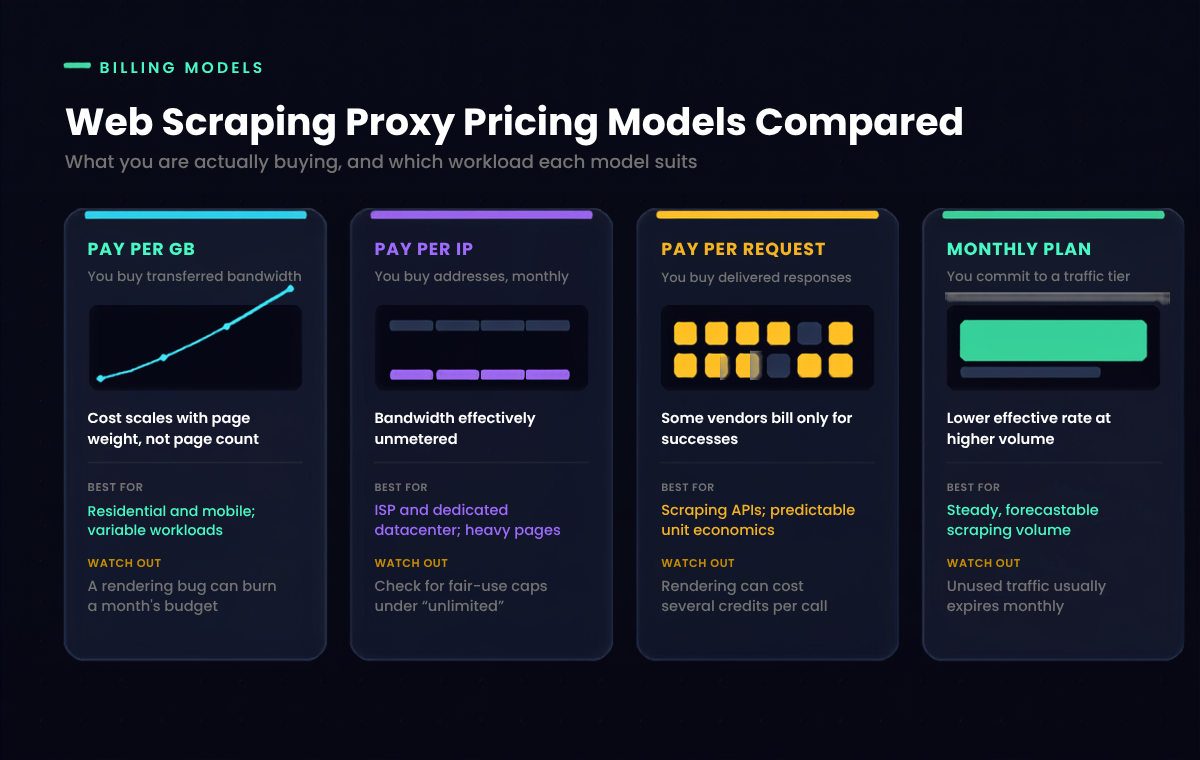
There is no single market price. Cost depends on proxy type, traffic volume, geography, billing model, session requirements, provider and any enterprise commitment.
- Pay per GB. You pay for transferred traffic — the residential and mobile default. Cost scales with page weight rather than page count, which punishes image-heavy targets. Good for variable workloads, dangerous without monitoring: a rendering bug can burn a month's budget overnight. Set hard usage alerts on day one.
- Pay per IP. You pay for a set of addresses, with bandwidth effectively unmetered — the ISP and dedicated data centre model. Predictable and often far cheaper for heavy pages. Watch for fair-use allowances hidden under "unlimited" labels; some vendors pool an allowance across IPs.
- Pay per request. Common with scraping APIs. Ask two questions: are failures charged, and what is the credit multiplier for the request type you will actually send? Rendering often costs several credits per call.
- Monthly plans. The dominant model, usually with volume tiers and traffic that expires at month end. A plan sized for your peak month wastes money in quiet ones. A few providers offer non-expiring traffic, which is worth real money for lumpy workloads.
- Enterprise contracts. Negotiated, with the steepest discounts. Some providers now gate residential access behind compliance review entirely.
Why the cheapest proxy is not always the cheapest
Imagine Provider A at $1.50/GB and Provider B at $3/GB. At first glance A looks twice as cheap. But if A produces more retries, more blocked pages, more failed sessions and more engineering time, the real calculation is:
Total cost = proxy traffic + retries + infrastructure + engineering time + failed data collection
For business-critical scraping, reliability can be worth more than a lower headline rate.
How Many Proxies Do You Actually Need?
There is no universal number. Work through these in order.
- Bandwidth, if billed per GB. Pages × average page weight ÷ success rate. Measure your target's actual page weight with browser dev tools rather than using an average — a JSON endpoint might be 15 KB while a rendered retail page exceeds 8 MB. That is a 500x range.
- Concurrency, not IP count. With a rotating pool you are buying simultaneous connections. Start at 5–10 threads and increase until error rates climb. The ceiling is set by the target's tolerance, not your provider's capacity.
- IP count, only for per-IP products. One IP per persistent identity for logged-in work. For static crawling, enough addresses that no single IP exceeds a rate a human could plausibly produce.
- Geographic distribution. Ask for IP counts per target city before purchase.
Three illustrations: a daily price check on 500 products at 1.5 MB pages needs roughly 23 GB/month before retries, so the smallest paid plan covers it. A weekly 50,000-page crawl at 2 MB needs about 100 GB/week, pointing at 500 GB tiers. Twenty continuous logged-in accounts need no bandwidth planning at all — buy 20 ISP proxies and never rotate them.
Free Proxies vs Paid Proxies
Free proxies may look attractive for experiments. The problem is not only reliability — it is security.
A free proxy operator sees your traffic, and anyone can run one. Public free proxies have repeatedly been observed modifying traffic, stripping encryption and injecting content. "Free" means the business model is something other than your subscription.
The operational problems are also disqualifying: shared with thousands of users, already blocked almost everywhere, unstable uptime, no geographic guarantees, no support and no concurrency capacity.
Entry-level paid plans start around $4. Testing against free proxies teaches you nothing about production performance, because their failure modes are entirely different.
The one legitimate use is a throwaway connectivity check on a page you do not care about, sending nothing sensitive.
Proxy vs VPN for Web Scraping
A VPN routes a user's whole connection. Proxy infrastructure is built for applications that need many identities under programmatic control.
| Feature | Proxy infrastructure | VPN |
| Automated scraping | Strong fit | Limited |
| Large IP pools | Common | Usually limited |
| IP rotation | Per request, automatic | Manual reconnect |
| Concurrent identities | Thousands | One per connection |
| Geo-targeting | Country, city, ZIP, ASN | Usually country/region |
| Developer APIs | Common | Less common |
| Session control | Configurable, per-request | All or nothing |
Commercial VPN address ranges are also widely catalogued and blocked, so you inherit datacenter-level detectability without any of the flexibility. For occasional browsing a VPN is fine; for scraping workloads it is the wrong tool.
Proxy or Scraping API?
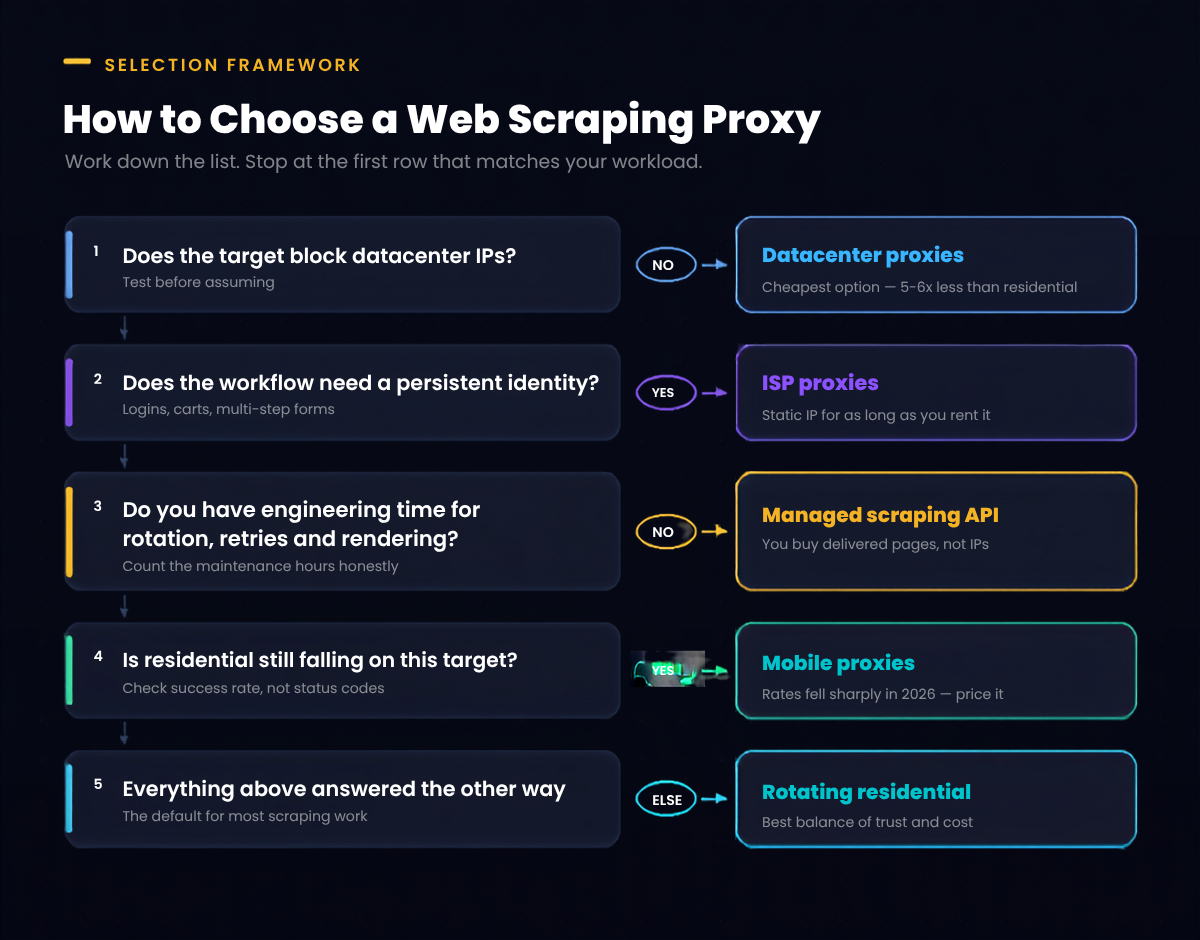
A proxy gives your scraper a network path. A managed scraping API handles much more of the stack: proxy rotation, browser rendering, retries, session handling, unblocking, extraction and infrastructure management.
Choose a proxy when you already have a working scraper, you want infrastructure control, the targets are manageable, you operate at a volume where per-request pricing gets expensive, or your workflow is unusual enough that a general-purpose API will not fit.
Choose a scraping API when your team does not want to maintain proxy infrastructure, browser rendering matters, the targets are complex, retries and unblocking consume too much engineering time, or your team mainly wants the final data. Vendors that bill only for successful responses effectively transfer retry risk to themselves.
The build-versus-buy test: estimate the monthly hours your team will spend maintaining rotation, retries, browser infrastructure and parsers. Multiply by a loaded hourly rate. Add it to the proxy bill and compare against the API quote. Small teams on hard targets usually find the API wins; large teams on tolerant targets usually find proxies win by a wide margin.
The right answer is often hybrid: proxies for the bulk of tolerant targets, an API for the handful of hard ones.
Ways to Improve Scraping Reliability
Good proxy infrastructure works best when the scraper itself is well designed. Polite scrapers genuinely have higher success rates, because most blocking is triggered by traffic patterns rather than identity.
Reasonable request rates. Start slower than you think necessary — one request per second per target is a sensible opening position. Many sites publish a preferred rate in robots.txt.
Retry with exponential backoff and jitter. Wait 1s, then 2s, 4s, 8s with randomness added, and cap retries at three. Retrying immediately at full rate turns a temporary throttle into a permanent block.
Read status codes properly. 429 means slow down and respect Retry-After. 403 usually means the identity was rejected, so rotate. 503 often means the site is struggling — back off hard. Treating all failures identically wastes bandwidth and worsens the cause.
Conditional requests and caching. Send If-Modified-Since and If-None-Match; a 304 costs almost no bandwidth. This is the single largest avoidable cost in most scraping budgets.
Session consistency. Keep sessions stable when the workflow needs continuity.
Geographic matching. Use the location that matches the data you are collecting. A German-language page fetched through a Brazilian IP is an odd signal and often returns the wrong content.
Connection reuse. Keep-alive and connection pooling reduce handshake overhead materially.
Fetch less. Skip images, fonts, ads and analytics. Prefer JSON endpoints over rendered HTML. Use a headless browser only where rendering is genuinely required.
Monitor success rate as a first-class metric, tracked per target, per proxy type, per region and per hour, with alerts on the rate of change rather than just the level.
Clear failure handling. Distinguish timeout, block, missing page, parsing failure and temporary network issues — that makes provider performance diagnosable.
What this guide does not cover: techniques for defeating bot detection, solving CAPTCHAs, or spoofing browser fingerprints. Those methods sit on the wrong side of both current litigation trends and most providers' acceptable use policies. Any guide promising guaranteed anti-bot bypass, 100% success or undetectable scraping is selling something it cannot deliver
Vendor Due Diligence: Where the IPs Come From
Where residential IPs originate became a serious procurement question in 2025 and 2026, and it is not an abstract ethical concern.
Several large botnets were monetised as residential proxy capacity — one reached around ten million compromised devices, and an Android-focused variant reached over two million and reportedly spread through other residential proxy networks. Law enforcement across the US, Canada and Germany disrupted several of them in March 2026, and the FBI published an advisory about residential proxy networks. Separately, Google took legal action that shut down more than ten China-linked proxy brands operating as storefronts for a single upstream supplier.
Two practical consequences for a buyer.
Unusually cheap unlimited residential traffic is a red flag. Legitimate providers face a hard cost floor from IP acquisition, servers and bandwidth. When a vendor offers unmetered residential access at a fraction of market rate, that capacity comes from somewhere — and several such brands have been directly linked to botnets.
Ask before you buy. How is the network sourced? Is there a named consent mechanism, such as a paid bandwidth-sharing app or a disclosed SDK? Which certifications does the company hold, and can it show them? Is there a published acceptable use policy and abuse response process? Vague answers, or "ethical sourcing" with nothing behind it, tell you what you need to know.
This matters commercially as well as ethically. If your data pipeline depends on infrastructure that gets seized, your pipeline stops.
Legal and Ethical Context
This is general information, not legal advice. The position is jurisdiction-specific and evolving — consult a lawyer for your use case.
In the United States, case law has settled reasonably clearly on one point: accessing publicly available data while logged out is generally defensible under computer-access law. Van Buren v. United States (Supreme Court, 2021) narrowed what counts as exceeding authorised access. hiQ Labs v. LinkedIn (Ninth Circuit, 2022) held that scraping public profiles did not violate the Computer Fraud and Abuse Act. In January 2024, a federal court granted summary judgment to Bright Data in Meta v. Bright Data, holding that Meta's terms governed logged-in use and did not bar logged-off scraping of public pages.
Three qualifications matter enormously.
Contracts survive where the statute does not. hiQ won on the CFAA and then lost on breach of LinkedIn's user agreement, which it had accepted by creating accounts — ending in a settlement with a substantial judgment, a permanent injunction and destruction of the scraped data. The line that keeps winning is logged-out versus logged-in.
The legal question has moved from "was it public" to "did you circumvent something." Current litigation, including Reddit's suit against Perplexity and several data-collection intermediaries filed in late 2025, centres on anti-circumvention claims alleging that rate limits and anti-bot measures were defeated. That theory targets the method of access, not the publicness of the data — which is precisely why this article does not cover evasion techniques.
Personal data is governed separately. GDPR applies to personal data whether or not it is publicly visible, and regulators have imposed substantial fines for scraping personal information from public sources. Non-personal data — prices, listings, availability, rankings — sits outside GDPR. New in 2026, the EU AI Act requires general-purpose AI providers to publish summaries of training data sources including top domains and to respect copyright opt-outs.
A defensible operating posture: collect public, logged-out pages as an ordinary visitor would; do not create accounts to access data you then scrape at scale; do not defeat authentication, paywalls or protection measures; honour robots.txt; collect facts rather than copyrighted creative expression; avoid personal data without a documented lawful basis; rate-limit so you never degrade the target's service; prefer official APIs where they exist; and document your purpose and legal review.
Common Mistakes When Choosing a Scraping Proxy
Choosing only by price. Low bandwidth pricing means little if the proxy performs badly on your targets. The metric is cost per successful page.
Choosing only by IP pool size. Above roughly 30–40 million IPs it predicts nothing. Coverage depth in your specific locations does.
Using residential proxies everywhere. Residential traffic costs five to six times more. Test datacenter first and upgrade only on evidence.
Rotating too aggressively. Some workflows need continuity. Changing IP on every request is counterproductive when a session must remain stable.
Sticking when you should rotate. One IP for a 50,000-page crawl concentrates the whole footprint on a single address.
Ignoring geography. A country-level IP may not reproduce city-level or state-level results.
Ignoring gateway location. A single US gateway means poor latency everywhere else, regardless of pool size.
Not monitoring success rate. Scrapers degrade quietly. Without per-target monitoring you find out from a stakeholder.
Rendering pages you do not need to render. Headless browsers multiply bandwidth and cost.
Not caching. Re-fetching unchanged pages is the largest avoidable cost in most budgets.
Skipping vendor due diligence. Unusually cheap unlimited residential traffic has a supply chain.
Trusting provider claims blindly. Provider-reported metrics are useful, but your own targets matter more. Every credible provider offers a trial.
Best Proxy by Situation
| Your priority | Strong starting point |
| Balanced general scraping | Decodo |
| Enterprise infrastructure and compliance | Bright Data |
| Highest measured performance at scale | Oxylabs |
| Low-cost self-service | Webshare |
| Flexible residential purchasing and clean IPs | IPRoyal |
| Detailed geo-targeting and long sessions | SOAX |
| Stable session workflows | NodeMaven / ISP proxies |
| Broad product mix, high-volume US | Rayobyte |
| Managed scraping | Zyte / Crawlbase |
These are starting recommendations, not guarantees. Verify the relevant product page before committing.
Which Proxy Is Best for You?
A simple decision path makes the choice easier.
Need the lowest practical cost? Start with datacenter if the target is easy to access.
Need better IP reputation? Test residential proxies.
Need a stable identity across several requests? Use ISP proxies or sticky residential sessions.
Need precise local results? Prioritise a provider with verified city, state, ASN or ZIP-level targeting.
Need very large scale? Compare enterprise platforms on concurrency, support, reliability and total cost.
Do not want to manage proxy infrastructure? Evaluate a managed scraping API.
This is a better selection method than choosing the provider with the highest ranking badge.
Frequently Asked Questions
What is the best proxy for web scraping?
There is no universal winner. Decodo is the strongest general-purpose starting point, combining the second-best measured success rate in 2026 independent benchmarks with mid-market pricing. Bright Data and Oxylabs suit enterprise-scale requirements, and Webshare is the best budget entry point. The right choice depends on the target, proxy type, geography, workload and budget.
Which proxy type is best for web scraping?
Residential proxies for most protected sites. Datacenter proxies for unprotected sites at a fifth to a sixth of the cost. ISP proxies where session stability matters. Mobile for the hardest targets — and worth pricing in 2026, since rates have fallen sharply.
Are residential proxies better than datacenter proxies?
Better at avoiding blocks, worse at everything else. Datacenter proxies are faster, more stable and five to six times cheaper. Independent 2026 benchmarks recorded a median 74.43% real-target success rate for residential against 57.46% for shared datacenter — a real gap, but not large enough to dismiss datacenter. Test the cheaper option first.
What is the best proxy for Google scraping?
Residential or mobile, rotating, geo-matched to the locale you are measuring. Search engines are among the hardest common targets, and in 2026 testing only a few networks opened them at a reasonable rate. For most teams a dedicated SERP API is the better purchase.
What is the best proxy for Amazon scraping?
Rotating residential, geo-matched to the marketplace, since pricing and availability differ by region. Amazon opened relatively evenly across networks in 2026 testing, so the differentiator is cost per successful page rather than provider choice. Fetch HTML without image assets to control bandwidth.
Are rotating proxies good for web scraping?
Yes, for stateless work — product pages, listings, search results. Rotation spreads your footprint so no single IP absorbs the blocking. They are the wrong choice when the site must recognise you across requests.
When should I use a sticky proxy?
Whenever several requests belong to one workflow: logins, carts, multi-step forms, paginated results behind a session cookie. Check the provider's default rotation interval — several auto-rotate after 60 seconds of inactivity. For sessions lasting hours, buy ISP proxies instead.
How many proxies do I need?
With rotating pools you are buying bandwidth and concurrent connections rather than IPs. Calculate pages × page weight ÷ success rate for bandwidth, then start at 5–10 threads and raise until errors climb. Only per-IP products make IP count the binding constraint.
Are free proxies safe?
No. The operator sees all traffic passing through, and public free proxies have repeatedly been observed modifying traffic and stripping encryption. They are also shared, slow, already blocked almost everywhere, and useless for testing. Paid plans start around $4.
Are proxies better than VPNs for scraping?
Yes. A VPN gives your whole machine one IP at a time with manual switching, while scraping needs many concurrent identities under programmatic control. Commercial VPN ranges are also widely catalogued and blocked.
How much do web scraping proxies cost?
In March–April 2026 standardised comparisons, residential ran at a median of roughly $3.75/GB at 5 GB, $3.00/GB at 50 GB and $2.25/GB at 500 GB. Shared datacenter ran roughly $0.45–$0.54/GB. Mobile ranged from about $4.38/GB down to $2.48/GB. Scraping APIs price per request instead. Rates change frequently — verify on the provider's pricing page.
When should I use a scraping API?
When proxy management, browser automation, retries, unblocking or extraction consumes too much engineering time. Estimate monthly maintenance hours, multiply by a loaded hourly rate, add it to the proxy bill and compare against the API quote.
Is web scraping legal?
Generally yes for publicly accessible data collected while logged out, in the US, under Van Buren (2021), hiQ v. LinkedIn (2022) and Meta v. Bright Data (2024). But contracts you accepted still bind you, privacy law governs personal data regardless of public visibility, and current litigation increasingly targets circumvention of protection measures. This is not legal advice.
Conclusion
The best proxy for web scraping is the one that produces the data you need at a sustainable total cost.
For most users, Decodo is the strongest starting point. It combined the second-best residential success rate and the fastest global response time in 2026 independent benchmarks with pricing at the market median, plus residential, datacenter, ISP and mobile products on one account.
For enterprise teams, Oxylabs and Bright Data deserve close attention. Oxylabs topped the measured benchmarks outright; Bright Data offers the widest product suite and the most complete compliance certification set, though its performance claims are provider-reported rather than independently verified.
For smaller budgets, Webshare and IPRoyal are attractive — Webshare for its halved rates and unusually strong datacenter real-target performance, IPRoyal for the cleanest measured IP reputation and flexible purchasing.
For session-heavy workflows, SOAX led on measured session persistence, and ISP proxies from any credible provider are the right answer when you need indefinite identity.
And when the real problem is not "which IP should I use?" but "why am I spending so much engineering time maintaining this scraper?", a managed solution such as Zyte or Crawlbase is likely the better answer.
The smartest way to choose is simple: pick the least expensive proxy type that reliably handles your real target, then scale only after testing. Two hundred requests against your own URLs will tell you more than every comparison article combined, including this one.
The UrwaTools Editorial Team delivers clear, practical, and trustworthy content designed to help users solve problems efficiently. Our articles focus on accurac...