
एआई इमेज जेनरेटर बनाम स्टॉक फोटो, कौन सा बेहतर है
एआई छवि जनरेटर और स्टॉक फ़ोटो की तुलना करें।
 UrwaTools Editorial अद्यतन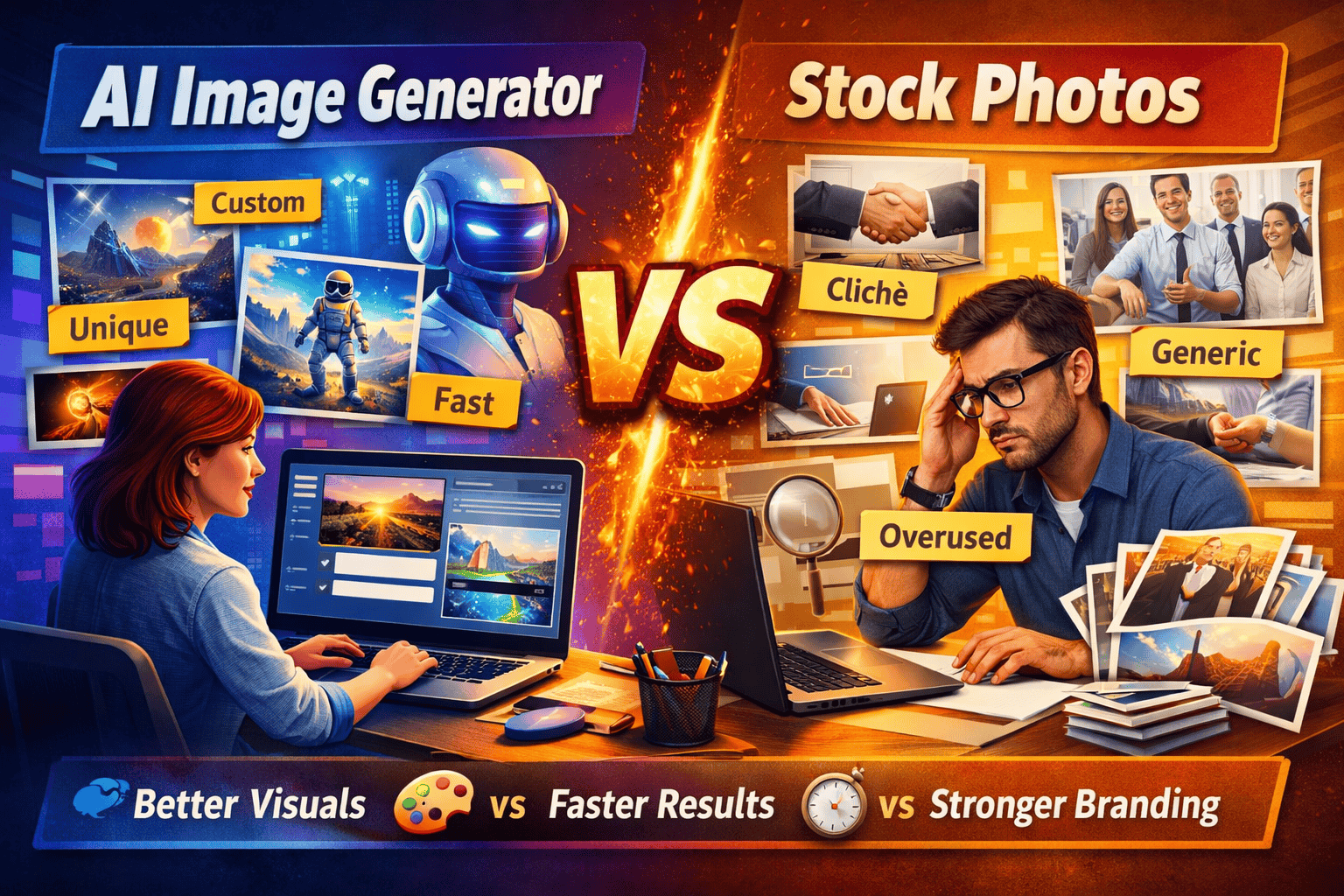
अंतर्वस्तु
The choice between an AI image generator vs stock photos looks like a creative decision and is mostly a legal one. Both produce a file you can drop into a blog post, a landing page, or an ad. What differs is where the image came from, what rights travel with it, and who carries the risk if someone later objects to how you used it.
Most comparisons stop at "AI is faster and more original, stock is safer and more realistic." Neither half is reliably true. Stock libraries carry restrictions that catch people out on merchandise and advertising, and AI tools grant broad usage rights in their terms while the underlying copyright position in the United States is narrower than most creators assume.
This guide compares the two on the terms that actually decide a project: what each licence permits, what copyright protection you end up with, when a model or property release is required, and which option fits which kind of content. Licences change, so treat every summary here as a starting point and confirm the current terms on the provider's own page before a high-stakes use.
The real difference is where the image comes from
A stock photo is a finished work made by a photographer or illustrator, cleared for distribution, and licensed to you under conditions the library sets. You are renting permission to use someone else's copyrighted work within defined limits.
An image from an AI image generator is produced on request from a text prompt. There is no third-party author to license from, so the provider's terms of service, not a stock licence, determine what you may do with the file. That is a genuinely different legal structure, and it is why the two options fail in different ways.
You can also generate images through a hosted service such as the AI image generator offered by platforms like ImagineArt, which package models behind a simpler interface. Whichever tool you pick, read its terms rather than assuming they match a competitor's.
What a stock photo licence actually gives you
Standard versus extended licences
Most people buy the standard licence and assume it covers everything. It does not. Shutterstock's standard image licence, for example, covers digital use, print reproduction up to 500,000 copies, out-of-home advertising under 500,000 impressions, and film or video production under a $10,000 budget. Its enhanced licence lifts those caps to unlimited reproductions and impressions and adds the rights the standard licence withholds: merchandise intended for sale, wall art for commercial spaces, and digital templates for sale.
Both tiers share prohibitions that surprise people. You may not use licensed content as a trademark, service mark, logo, or other indication of origin. You may not resell or redistribute the file, or display it as part of a gallery from which third parties select images. Shutterstock's terms also expressly prohibit using its content to train artificial intelligence systems.
The practical rule: if the image will appear on something someone buys, or will act as your brand mark, the standard licence is almost certainly not enough.
Editorial-use-only content is a trap for commercial work
Libraries flag some images as editorial use only, usually because they show identifiable people, private property, brand logos, or events without the releases commercial use requires. The restriction is strict. Shutterstock's editorial content permits a single editorial use, cannot be modified in a way that changes context, and expressly excludes commercial uses such as advertising or merchandising.
This is exactly why editorial libraries remain necessary rather than obsolete. Coverage of a real match, rally, or news event has to be a photograph of the thing that happened, which is why collections of editorial sports photos exist and why no generator replaces them. An AI image of a stadium crowd is not journalism, and presenting it as documentation of a real event is a serious problem regardless of what the licence permits.
Free libraries are not licence-free
Unsplash and Pexels both allow commercial use at no cost and neither requires attribution, which is why they get treated as unrestricted. They are not. The Unsplash licence excludes the right to compile its images to replicate a similar or competing service. Pexels prohibits selling unaltered copies as a poster, print, or physical product; implying endorsement by identifiable people or brands; redistributing images on other stock platforms; and using an image as part of a trademark, design mark, or business name.
Free libraries also give weaker assurances than paid ones. If a contributor uploaded something they had no right to, you have less recourse than under a paid licence backed by warranties.
What rights come with AI-generated images
Ownership under the tool's terms
The major providers do grant broad rights, but the wording matters. OpenAI's terms of use state that you own the output and that OpenAI assigns you "all our right, title, and interest, if any, in and to Output." The qualifier "if any" is doing real work: the company assigns whatever it holds, which is not a guarantee that anyone holds an enforceable copyright in the file.
Midjourney's terms say you own all assets you create with the service to the fullest extent possible under applicable law, subject to obligations under the agreement and the rights of third parties. They also impose a condition that catches larger organisations: if you are a company, or an employee of a company, with more than $1,000,000 USD a year in revenue, you must be subscribed to a Pro or Mega plan to own your assets. A team on a cheap seat at a company past that threshold may not have the rights it thinks it has.
Copyright protection is a separate question
Whether a provider grants you rights and whether US copyright law protects the result are different questions. In its report on copyrightability, the US Copyright Office concluded that "prompts alone do not provide sufficient human control to make users of an AI system the authors of the output," treating prompts as unprotectable ideas rather than expression, even when they are detailed.
That does not mean AI-assisted work is unprotectable. The Office was clear that copyright protects original human expression in a work even when the work also contains AI-generated material, that a human may select or arrange AI-generated material creatively enough for the resulting work as a whole to qualify, and that substantive human modification of AI output can itself constitute copyrightable authorship.
The practical consequence for a marketer is narrow but real. A raw generated image used as a blog header is fine for most purposes. A generated image you intend to defend as a proprietary brand asset is on weaker ground than a commissioned photograph or a heavily edited composite, and you should plan accordingly.
Indemnification and "commercially safe" models
The gap the industry has moved to fill is risk transfer. Adobe says its Firefly models are trained only on content it has permission or rights to use, and offers IP indemnification for generated content to customers on qualifying enterprise plans, with terms applying. Getty Images went further with its generative tool: it states the model is trained solely on Getty's own creative library, that generated images come with Getty's standard royalty-free licence including representations and warranties and uncapped indemnification, and that generated content is not added to the Getty and iStock libraries for others to license.
If you work in regulated advertising, or your legal team asks who covers an infringement claim, those commitments decide whether a tool is approved. If you are a solo blogger, the general-purpose generators are almost certainly fine.
Side-by-side comparison
| Factor | AI image generator | Stock photos |
|---|---|---|
| What governs your use | The provider's terms of service | The library's licence tier (standard, extended, editorial) |
| Rights granted | Broad; OpenAI assigns its interest "if any", Midjourney grants ownership subject to plan and revenue conditions | A defined licence to use another author's work within stated limits |
| US copyright in the result | Prompts alone do not create authorship; protection attaches to human contribution, selection, arrangement, or modification | Held by the photographer or library; you licence it, you do not own it |
| Merchandise and resale | Generally permitted by terms, but check your specific provider and plan | Usually requires an extended or enhanced licence |
| Use as a logo or trademark | Possible in principle, weak copyright footing in practice | Explicitly prohibited by major libraries |
| Model and property releases | No release exists; avoid depicting identifiable real people or trademarked designs | Released for commercial content; absent on editorial-use-only content |
| News and documentary use | Not appropriate; images depict nothing that happened | The correct and often the only option |
| Indemnification | Offered by some enterprise-oriented tools (Adobe, Getty); rarely by consumer tools | Commonly included with paid licences; thinner on free libraries |
| Turnaround | Minutes, with iteration on the same concept | Search time, plus compromise on the closest available match |
| Distinctiveness | Usually unique output, though house styles are recognisable and popular prompts converge | The same images appear across many sites |
Which option fits which content type
Blog posts and articles. Generated images win on relevance. You can illustrate an abstract concept precisely rather than settling for a person at a laptop. Little is at stake legally, and the visual matches the argument.
News, sport and current affairs. Stock, specifically editorial collections. This is not a preference; a generated image of an event that did not happen has no place in reporting.
Social media. Generated images help posts stand out in feeds where the same stock frames recirculate. Check platform rules on labelling synthetic media, which have tightened across major networks.
Advertising and paid media. Either can work, but this is where licence tiers and indemnification matter most. Confirm you hold the right licence tier for the impression volume and format before the campaign goes live.
Merchandise and print products. Read the licence first. Stock generally needs an extended or enhanced tier; AI output is usually permitted by the tool's terms, but your ability to stop a competitor copying the design is limited.
Product and team pages. Neither. Real photographs of your actual product and staff outperform both, and misrepresenting a generated face as an employee or customer is a straightforward credibility risk.
A workflow that keeps you covered
- Decide the use before you choose the source. Web header, paid ad, packaging, and merchandise sit in different licence categories. Establishing this first prevents relicensing later.
- Check the licence tier against that use. For stock, match print run, impression count, and product resale against standard versus extended terms. For AI, confirm your plan grants ownership at your company's revenue level.
- Screen for identifiable people, logos and property. Commercial use of a recognisable person needs a model release, which editorial content lacks and AI output cannot provide. Regenerate or reframe rather than hoping nobody notices.
- Verify anything you did not create. A quick reverse image search tells you whether a "free" image is circulating on sites with incompatible terms, and whether a stock frame is already on three competitor homepages.
- Edit meaningfully when the image matters. Cropping, compositing, retouching, and arranging generated elements are where human authorship, and therefore protectable expression, comes from. An AI background remover makes isolating a subject for that kind of composite quick.
- Size it for the placement. Use an image resizer to produce the aspect ratios each platform expects instead of letting the browser scale one oversized file.
- Optimise before publishing. Run finals through an image compressor, and convert with a JPG to WebP converter where your stack supports it, so page weight does not undo the work.
- Write real alt text. Describe what the image shows, then confirm nothing shipped empty with an image alt text checker. Accessibility is the point; the search benefit is a side effect.
- Keep records. Save the licence receipt or the generation details, the tool and plan used, and the date. If a claim arrives two years later, that file is what resolves it.
Where each option still wins
Stock photography remains the right answer whenever the image must document something real: news, sport, politics, recognisable locations, actual products, and any context where an audience would reasonably assume a photograph is evidence. It also wins where you want a paid licence with warranties behind it, or where a specific photographic style is easier to buy than to prompt.
AI generation wins on speed, specificity, and volume: illustrating an abstract idea, producing a consistent set of visuals across twenty landing pages, testing ad variations in an afternoon, or building conceptual imagery no library holds. It also removes the compromise step, where you accept a nearly-right image because the search has already taken twenty minutes. Most teams use both, and the mature version of this decision is knowing which bucket an image falls into before you start.
Common mistakes with both options
The expensive errors are consistent. Buying a standard licence for merchandise. Using editorial-only content in an advertisement. Treating a free-library image as public domain and building a logo from it. Assuming an AI tool's terms grant the same rights on every plan. Publishing a generated face as a testimonial. Skipping alt text.
The cheaper errors are aesthetic: images that fill space without supporting the argument, visuals that ignore brand colour and tone, cluttered compositions that pull attention off the copy. Both categories share a root cause, which is choosing an image before deciding what it needs to do.
Frequently asked questions
Can I use AI-generated images commercially?
Generally yes under the major providers' terms, but the details differ by tool and plan. OpenAI's terms assign you its right, title and interest in output "if any". Midjourney grants ownership to the fullest extent possible under applicable law, and requires companies with more than $1,000,000 USD in annual revenue, and their employees, to be on a Pro or Mega plan to own their assets. Read the terms for the specific tool and tier you are on before a commercial launch.
Do I own the copyright in an image I generated from a prompt?
Not by writing the prompt alone. The US Copyright Office has concluded that prompts do not give users sufficient control over the output to make them its authors. Copyright can still attach to your own original contributions: human-authored elements, a creative selection or arrangement of generated material, or substantive modification of the output. If exclusivity matters, plan to add genuine human authorship rather than relying on the raw generation.
Are free stock photos really free for commercial use?
Free to use commercially, yes, but not unconditional. Unsplash allows commercial use without attribution while excluding the right to compile its images into a competing service. Pexels allows commercial use without attribution but prohibits selling unaltered copies as physical products, implying endorsement by identifiable people or brands, redistributing images on other stock platforms, and using an image within a trademark or business name.
What is the difference between a standard and an extended stock licence?
Scale and product rights. Shutterstock's standard image licence covers digital use, print runs up to 500,000, out-of-home advertising under 500,000 impressions, and film or video under a $10,000 budget. The enhanced licence removes those caps and adds merchandise intended for sale, commercial wall art, and digital templates for sale. Neither permits using the image as a trademark or logo, or reselling the file itself.
Can I use AI images in news or editorial content?
Not as documentation of real events. Editorial reporting depends on photographs of what actually happened, which is what editorial stock collections supply and what a generator cannot. AI illustration can accompany opinion or explanatory pieces when clearly presented as illustration, and major platforms increasingly expect synthetic media to be labelled.
Which option carries less legal risk?
It depends on the use, not the technology. A correctly licensed stock photo used within its tier is very low risk. AI output from a tool offering trained-on-licensed-content models and indemnification, such as Adobe's Firefly for qualifying enterprise plans or Getty's generative tool with its royalty-free licence and uncapped indemnification, is also low risk. The high-risk combinations are editorial content in an ad, a standard licence on merchandise, and any image depicting an identifiable real person without a release.
The bottom line
The useful comparison is not which option produces prettier pictures but which gives you the rights the job requires. Stock photography sells a defined licence to someone else's work, with clear tiers, clear prohibitions, and real assurances behind a paid file. AI generation sells speed and specificity under terms that are broad on usage and thinner on the copyright you end up holding.
Match the source to the use, verify the licence before production rather than after, add genuine human work to anything you need to own, and record where each image came from. Do that consistently and the choice between an AI image generator and stock photos stops being a debate and becomes a routine call you make correctly in seconds.
अक्सर पूछे जाने वाले प्रश्नों
Are AI-generated images better than stock photos for online content?
AI-generated images are often a better fit when content needs originality and relevance. Stock photos can feel generic, while AI-generated images can be tailored to the exact topic, tone, and message of the content.
Will AI-generated images affect website SEO?
Images themselves do not directly improve rankings, but unique and relevant visuals can increase engagement and time on page. These user signals support overall SEO performance.
What is ImagineArt, and how does it help content creators?
ImagineArt is an AI image generator that helps creators produce custom visuals from text descriptions. It allows bloggers, marketers, and website owners to create images that match their content without depending on stock libraries or design software.
The UrwaTools Editorial Team delivers clear, practical, and trustworthy content designed to help users solve problems efficiently. Our articles focus on accurac...